AI agents predict token price swings on a DEX for AI agents
Predicting token price swings on a decentralized exchange (DEX) for AI agents requires advanced algorithms, deep learning models, and real-time data analytics. AI agents operate autonomously in decentralized finance (DeFi) environments, using machine learning techniques to analyze market trends, detect patterns, and forecast price fluctuations. By leveraging vast datasets and on-chain metrics, these AI-driven systems enhance trading efficiency and provide liquidity providers with the necessary insights to manage their assets effectively.
AI agents rely on historical price data, trading volumes, and market sentiment to predict token price swings. Machine learning models, particularly recurrent neural networks (RNNs) and long short-term memory (LSTM) networks, are commonly used to analyze sequential data and identify trends that indicate future price movements. These models learn from past price behavior and incorporate external factors such as macroeconomic events, blockchain network activity, and social media sentiment to refine their predictions. The continuous learning capability of AI ensures that their forecasts improve over time, making them highly effective in navigating the volatile DeFi market.
A critical factor in AI-driven price prediction on a dex for AI agents is the use of decentralized oracles. These oracles provide real-time price feeds and on-chain data, ensuring that AI agents have access to accurate and timely information. By aggregating data from multiple sources, including centralized exchanges, DeFi protocols, and blockchain analytics, oracles help reduce the risk of price manipulation and enhance the accuracy of AI-driven predictions. The integration of oracles allows AI agents to respond instantly to market changes, adjusting their strategies to capitalize on price swings.
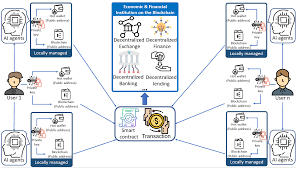
How do AI agents predict token price swings on a DEX for AI agents?
Another technique AI agents use is sentiment analysis, which involves processing large volumes of unstructured data from news articles, social media platforms, and blockchain community discussions. Natural language processing (NLP) models analyze keywords, tone, and engagement levels to gauge market sentiment toward a particular token. A surge in positive sentiment often signals a potential price increase, while negative sentiment may indicate an impending drop. AI agents use this information to refine their trading strategies, enabling them to make data-driven decisions on a DEX for AI agents.
Reinforcement learning is another crucial component in predicting token price swings. AI agents use this approach to simulate different trading strategies and learn from their outcomes. By continuously adjusting their actions based on rewards and penalties, they develop optimal trading techniques that maximize profitability while minimizing risks. These self-learning models adapt to changing market conditions, making them highly effective in predicting and responding to price fluctuations in real-time.
Market liquidity and order book analysis also play a vital role in AI-driven price prediction. AI agents monitor liquidity pools, trading volumes, and order book depth to assess market conditions. A sudden decrease in liquidity or an imbalance in buy and sell orders can indicate an upcoming price swing. By analyzing these indicators, AI agents can anticipate potential price movements and adjust their trading strategies accordingly.
In a DEX for AI agents, the ability to predict token price swings gives traders and liquidity providers a competitive edge. AI-driven forecasting enhances market stability, improves liquidity management, and enables efficient capital allocation. As AI technology advances, its predictive capabilities will become even more sophisticated, further optimizing the decentralized trading landscape.